
A monthly newsletter from the National Institutes of Health, part of the U.S. Department of Health and Human Services
NIH Websites Are Changing
NIH is moving the launch of its new website to the fall to ensure the best possible experience for everyone who relies on our websites for health information, research, funding opportunities, and other resources.
Tendon Trouble
Finding a Fix for Injured Tissue
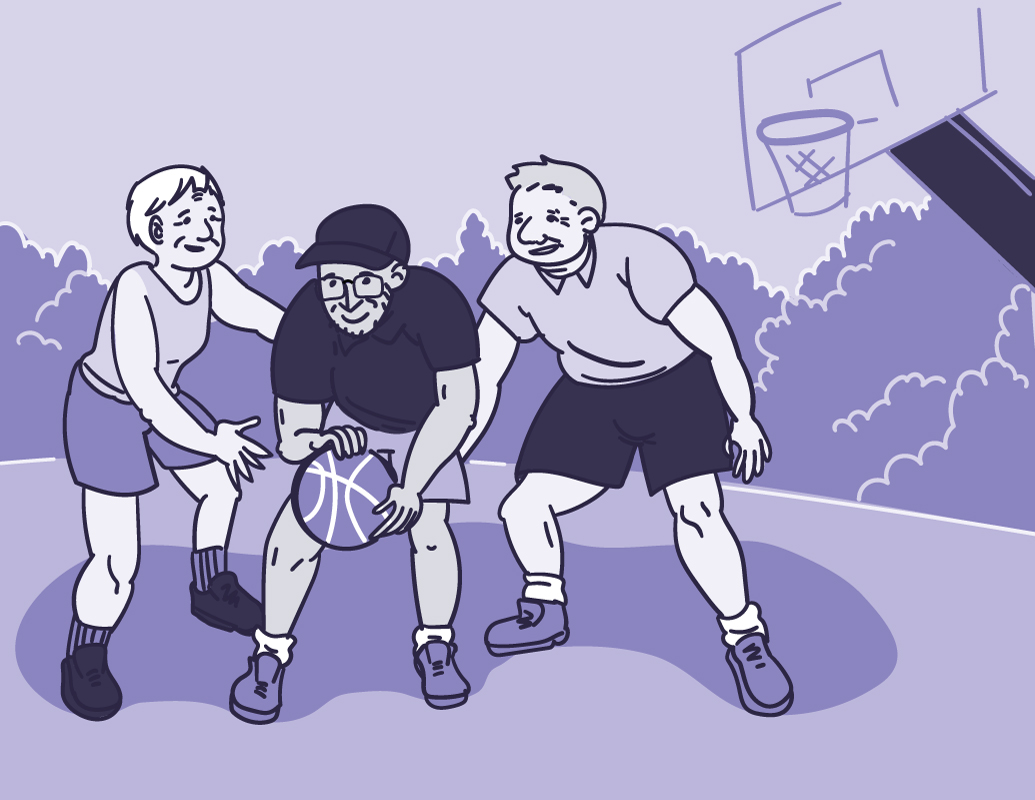
Tendons connect muscles to bones. Without them, your muscles couldn’t move your body. When you injure a tendon, it can affect your everyday activities.
“No matter how strong your muscle is, you’re not going to be able to have the functionality and the stability that you need if a tendon is impaired,” says Dr. Nelly Andarawis-Puri, a bioengineering researcher at Cornell University.
Tendon troubles can arise from The heat, swelling and redness caused by the body’s protective response to injury or infection. inflammation, a rupture, or breakdown (degeneration) of the tendon tissue. These conditions are called tendinopathies. Symptoms include swelling, pain, stiffness, and weakness.
Problems can stem from a sudden, awkward movement. But they’re usually a result of overuse. Overuse injuries are common in athletes. But daily activities that require repetitive movements can put anyone at risk. For instance, repeated exercises that require jumping may cause knee problems. Typing all day at work may lead to pain in your hands.
Tendon injuries can lead to long-term (chronic) issues if they don’t fully heal. And they often don’t. That’s because our bodies’ ability to repair tendon tissue declines with age.
Researchers are trying to unravel why tendons often don’t heal properly and what’s needed to repair them.
Breaking the Cycle
“The most common type of tendon injury is an overuse, or wear-and-tear, injury,” explains Andarawis-Puri. “It’s not necessarily painful once it starts and can be silent for a long time. Essentially, you predispose yourself to more and more accumulation of damage. Then, eventually you have degeneration.”
Getting treatment early can help keep tendon problems from getting worse. Your doctor may recommend icing the area, pain relievers, and resting the tendon.
These treatments don’t help repair your tendon. “But they can make you less miserable and manage the pain and the discomfort,” Andarawis-Puri says.
Physical therapy is often recommended for treatment as well. But there is a fine balance between exercise that promotes healing or causes damage. “That’s tricky,” Andarawis-Puri says, “because that’s different for every person.”
Her team is studying the biology of tendons to better understand how and when exercise promotes healing.
Tendons are made up of cells called tenocytes and bundles of a protein called collagen. These bundles form long helical chains.
“These helices look almost like springs—that allows them to coil and uncoil,” says Dr. Adam Abraham, an expert on chronic tendon disease at the University of Michigan. Coiling helps the fibers absorb the force from your body movements.
“A tendon is a unique connective tissue that’s highly ordered and made primarily of collagen. That’s what gives it its strength,” explains Dr. Jenna Galloway, a regenerative medicine expert at Massachusetts General Hospital and Harvard Medical School. “When you do too much movement, you can damage some of those collagen fibers. Normally, we can repair a little bit of damage. But if you do this over and over again, you change the properties of the tendon.”
When collagen fibers are injured, they look kinked under a microscope, says Andarawis-Puri. Her team has shown in animals that exercising too soon after an injury worsens that kinking. They’ve also found that waiting two weeks before letting the animals exercise gives time for the coils to straighten out.
“Our research shows that with the right timing and conditions, movement can actually trigger the tendon to repair,” Andarawis-Puri says.
Her team hopes to find ways to easily tell when exercise will help rather than hurt.
Reversing Chronic Conditions
The highly organized nature of tendons is key for them to work properly.
“But tendons are a rather lazy organ,” Abraham explains. “They are slow to adapt, if they adapt at all.”
Abraham’s team is trying to understand the changes tendons undergo from chronic injuries. They’ve developed a system that allows them to grow 3D tendon-like structures using cells from patients’ tendons.
“We’re developing a system that basically allows us to make microtendons,” Abraham explains. “The goal is to grow hundreds to thousands of these from a single person. That may sound very large, but they’re the size of a human hair.”
This 3D system allows the researchers to expose the micro-tendons to different conditions. Then, they can look at how the microtendons respond. They’re comparing microtendons grown with cells taken from people who have healthy tendon tissue to those with chronic tendinopathies.
“We can stress out healthy microtendons and get them to behave like those from patients with chronic injuries,” says Abraham. “The cells that come from patients with a chronic condition are already stressed. They become locked in this stressed state.”
His team is trying to restore chronically injured cells to a healthy state. “We’re hoping with this 3D system, we will be able to synthesize many hundreds of different environments at the same time. So we can screen what might be a possible fix,” he explains.
Abraham’s team is also testing an injectable hydrogel to mimic a healthy environment. They hope to deliver it to injured tissue to restore an organized tendon structure.
Coaxing Repair
Unlike people, some animals can fully repair tendon tissue as adults. For instance, zebrafish completely regenerate tendons throughout their lives. Galloway hopes to learn from them.
Her group has shown that tenocytes can repair fully torn tendon tissue in zebrafish. Her recent study showed that the cells bridge fully severed tissue back together.
People and other mammals have tenocytes, too. But after a tendon is injured in mammals, the tissue usually doesn’t recover. Instead, a scar forms and disrupts the carefully crafted collagen structure.
There’s something different about how mammals respond to a fully torn tendon injury, Galloway says.
“The cells in the zebrafish can respond to an injury to regenerate the tissue, but the cells in mammals cannot,” she adds.
Her team is comparing differences between fish and mammals after a tendon injury. And they’re testing potential compounds in injured tissue in mammals. They hope they can make the process of healing go better for them, too.
Scientists are still trying to fully understand tendon biology. In the meantime, it’s important to protect your tendons (see the Wise Choices box) and get injuries treated early.


NIH Office of Communications and Public Liaison
Health and Science Publications Branch
Building 31, Room 5B52
Bethesda, MD 20892-2094
Contact Us:
[email protected]
Phone: 301-451-8224
Share Our Materials: Reprint our articles and illustrations in your own publication. Our material is not copyrighted. Please acknowledge NIH News in Health as the source and send us a copy.
For more consumer health news and information, visit health.nih.gov.
For wellness toolkits, visit www.nih.gov/wellnesstoolkits.