
A monthly newsletter from the National Institutes of Health, part of the U.S. Department of Health and Human Services
NIH Websites Are Changing
NIH is moving the launch of its new website to the fall to ensure the best possible experience for everyone who relies on our websites for health information, research, funding opportunities, and other resources.
Professor Thymus
Training the Body to Fight Disease
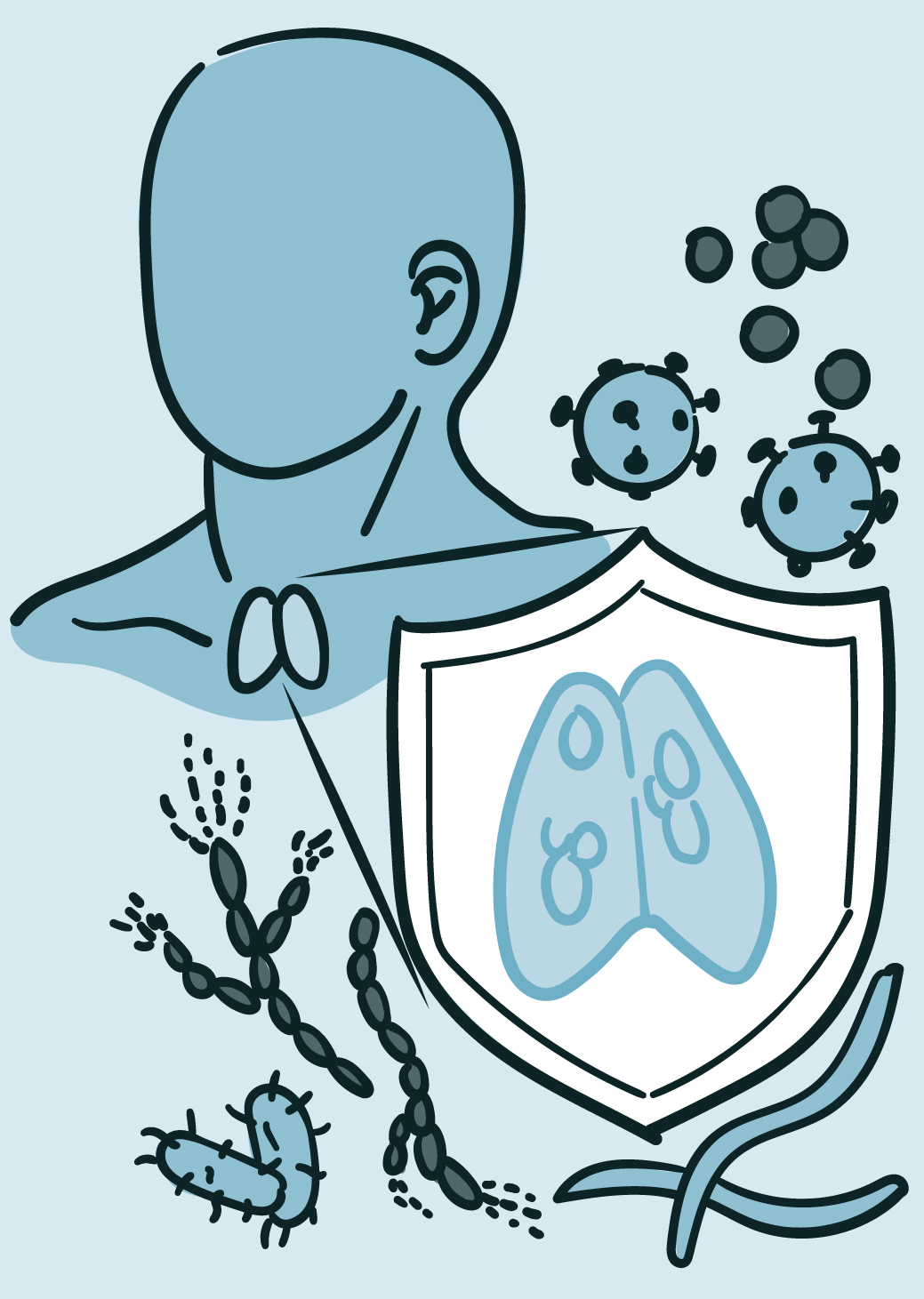
Just as children learn in school, some of the cells that protect us from disease also need an education. Cells called T cells attend class in the thymus. The thymus teaches the T cells what to attack and what to leave alone to keep us healthy. Researchers are studying how the thymus trains these cells, with the goal of finding new ways to boost disease-fighting abilities.
T cells are one of the most important parts of our body’s disease defense system, called the immune system. The immune system is made up of many different cells that defend us from threats like bacteria and viruses.
The thymus is the reason for the “T” in T cell. After they are born, immature T cells travel to the thymus. Once there, they mature and specialize. They also learn how to recognize friend from foe. Afterward, the thymus tells the mature T cells where in the body to go.
“Those cells come into the thymus as kind of a blank slate, much like children come to school,” explains Dr. Kristin Hogquist, an expert on the immune system at the University of Minnesota. “And then the thymus is where they get all of the sophisticated instructions about how to function.”
Some babies are born without a thymus. Not having a thymus leaves these babies at risk for life-threatening infections. They also often develop illnesses called autoimmune diseases. Those illnesses occur when your immune system attacks your body.
Babies born without a thymus can’t survive more than a few years without treatment. Fortunately, doctors can take a piece of the thymus from a donor and put it into a baby’s body.
“That piece of thymus will attract immature T cells, and it will build a school where those T cells can be educated,” Hogquist says.
For a long time, scientists thought that adults didn’t need a thymus. That’s because the thymus naturally shrinks and becomes less active as we age. But new research is showing that the thymus remains important in adulthood.
Some of that research involves studying adults who had part or all of their thymus removed. The thymus is in the upper part of the chest, so “surgeons will sometimes remove part of the thymus to gain access to the heart,” Hogquist says.
A recent NIH-funded study looked at adults who have had their thymus removed. The study found that removing a person’s thymus made it more likely they would die from cancer or an autoimmune disease. Another study found that adults with a more active thymus might be less likely to die from any cause.
Learning more about the thymus could lead to ways to make it more active in adults. Hogquist is trying to figure out what molecules the thymus uses to teach our T cells.
“You can try to restore a whole functioning thymus to fix one of the problems in it, or you can provide one molecule,” explains Hogquist. “But we’ve got to know what those molecules are.”
See the Wise Choices box to learn more about what can harm the thymus and make it harder for your body to fight infections.


NIH Office of Communications and Public Liaison
Health and Science Publications Branch
Building 31, Room 5B52
Bethesda, MD 20892-2094
Contact Us:
[email protected]
Phone: 301-451-8224
Share Our Materials: Reprint our articles and illustrations in your own publication. Our material is not copyrighted. Please acknowledge NIH News in Health as the source and send us a copy.
For more consumer health news and information, visit health.nih.gov.
For wellness toolkits, visit www.nih.gov/wellnesstoolkits.