
A monthly newsletter from the National Institutes of Health, part of the U.S. Department of Health and Human Services
NIH Websites Are Changing
NIH is moving the launch of its new website to the fall to ensure the best possible experience for everyone who relies on our websites for health information, research, funding opportunities, and other resources.
Wearable Tech
Providing Insights into Health
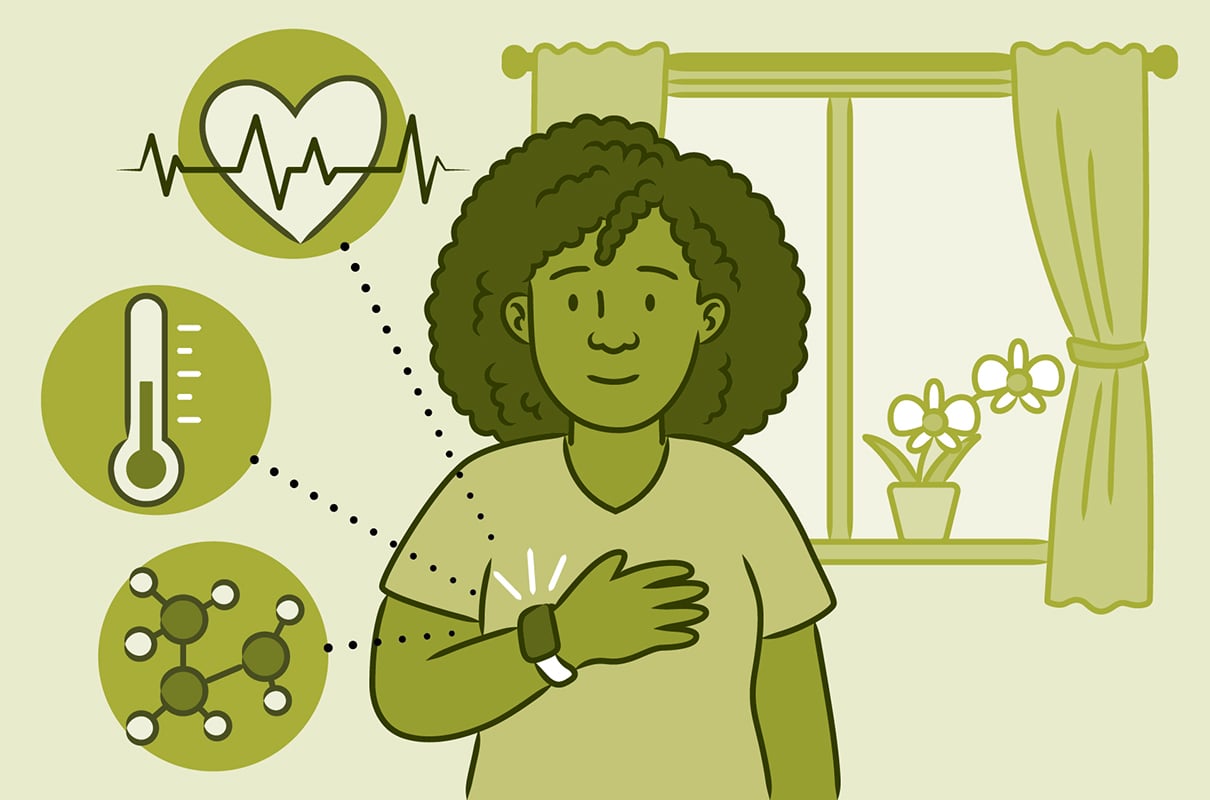
Millions of Americans wear devices that track information about their health. These devices count steps, check heart rates, and help monitor fitness. They can be worn against the body or in clothing. Examples include smartwatches, rings, and headbands.
Wearable devices collect signals from the body using tiny sensors. These signals are translated into data on health apps. Researchers are studying how wearable devices can be helpful for many different health conditions including infections, diabetes, heart conditions, and more.
One large NIH initiative is analyzing health data from nearly 900,000 volunteers around the country. It’s called All of Us. Over 68,000 of the participants share data from Fitbit wristbands about their heart rate, sleep, and physical activity.
“The data provides researchers with ongoing insights into an individual’s lifestyle and how it can impact their health,” says Dr. Josh Denny, who oversees the NIH All of Us Research Program. “That can help them design treatments that will have a positive impact.”
Other NIH-funded researchers are studying different types of wearables. They’re looking at whether the data can better identify or manage health conditions.
Improving Reproductive Health
Wearable devices may offer insight into women’s reproductive health. Tracking your menstrual cycle and knowing when to expect your period can be helpful for women. This can be especially true for those trying to get pregnant or avoid pregnancy.
During the menstrual cycle, an ovary releases an egg to be fertilized. This is called ovulation. Eggs are released in response to certain hormones.
Right now, women who want to track ovulation have two options. They can test their urine daily for luteinizing hormone. Or, when they wake up, they can take their resting body temperature by mouth each day. Body temperature rises after ovulation. Both ways can be used to predict ovulation.
But both options can be burdensome for women, says Dr. Anne Marie Jukic, an NIH reproductive health expert. She and her collaborators have tested an easier option: smartwatch sensors that measure wrist temperature.
“Few studies had looked at whether wrist temperature can identify ovulation or predict the start of the next menstrual period,” Jukic says.
The study enrolled 262 women and girls to track information about their cycles. Participants wore a smartwatch to track their daily wrist temperatures. They logged the dates of their periods as well. They also tested their urine daily for luteinizing hormone and recorded their body’s resting temperature. These common ways of predicting ovulation were compared with the wrist temperature results.
Wrist temperature could predict most women’s ovulation date within two days of the actual date. It could also predict when their next period would start within three days for most women.
“Using a passive wearable sensor made it easy to identify ovulation and when the next menses might occur,” says Jukic. “This makes menstrual cycle tracking and understanding cycle patterns more accessible to people.”
Detecting Diseases
Wearable devices may be helpful for detecting certain diseases. Our bodies naturally let out tiny molecules that may give off distinct odors. These can be released through breath, skin, or urine.
Researchers can identify profiles, or “signatures,” for groups of molecules given off by the body. Certain diseases may change these profiles. Scientists are testing wearables to identify the signatures of odors that are linked to 20 different diseases. These include skin, lung, joint, and connective tissue diseases.
“We’re trying to figure out which groups of chemicals fit a particular disease,” says Dr. Cristina Davis, a mechanical engineer at the University of California, Davis. Her lab is developing devices that detect and analyze the odors.
They’ve designed a system that uses a wearable patch to collect molecules from your skin. The patch can fit on your forearm. Right now, the researchers must analyze the molecules in the lab. But they’re working on developing a patch that can analyze the molecules itself.
The team is also developing an electric glove to collect information. Sensors in the glove measure vital signs such as heart rate, skin temperature, and sweat.
“Combining information from the two wearable devices has improved their ability to detect diseases,” Davis says.
The researchers are now building computer models to help link the molecules to health or disease.
Screening for Risk
Wearable devices are already being used to help manage certain health conditions. Continuous glucose monitors, for example, use a tiny plastic tube inserted under the skin to help people with diabetes track and manage their condition.
Researchers are testing whether other wearable devices can help identify people at risk for diabetes before symptoms appear.
Type 2 diabetes happens when your body doesn’t use insulin well. Most of the food you eat is broken down into sugar and released into your bloodstream. Insulin is a hormone that helps control your blood sugar levels.
When your body doesn’t use insulin well, your blood sugar rises above normal levels. That can lead first to a condition called prediabetes. Prediabetes increases your risk of developing type 2 diabetes. But not everyone goes on to develop diabetes. You can reduce your risk if you catch the signs early and make certain lifestyle changes.
People can have prediabetes for years without symptoms. This means you may not know you have prediabetes until serious health problems show up. A blood test is currently the only way to diagnose prediabetes.
NIH-funded researchers want to help more people get screened for prediabetes. “When someone is aware of their prediabetes status, they’re more likely to make lifestyle changes such as exercise and a healthy diet,” says Dr. Jessilyn Dunn, a biomedical engineer at Duke University.
Dunn’s team is studying ways to alert people to signs of prediabetes using wearables like smartwatches. Digital devices can collect data linked to your risk of prediabetes.
The team is exploring if sending text messages to people whose data show they are at high risk will make it more likely that they go to the doctor. “We want to urge people with a higher risk to talk to their doctor about screening for prediabetes,” Dunn says.
Other researchers are exploring more ways to use wearables to support people’s health. See the Wise Choices box to learn more.




NIH Office of Communications and Public Liaison
Health and Science Publications Branch
Building 31, Room 5B52
Bethesda, MD 20892-2094
Contact Us:
[email protected]
Phone: 301-451-8224
Share Our Materials: Reprint our articles and illustrations in your own publication. Our material is not copyrighted. Please acknowledge NIH News in Health as the source and send us a copy.
For more consumer health news and information, visit health.nih.gov.
For wellness toolkits, visit www.nih.gov/wellnesstoolkits.