
A monthly newsletter from the National Institutes of Health, part of the U.S. Department of Health and Human Services
Search

Midlife Eating Linked to Health Decades Later
… As the U.S. population ages, there’s growing interest in finding ways to protect our physical and mental health. A new study looked at how what we eat in midlife affects our health later on. An NIH-funded team analyzed data from more than 105,000 men and women. Participants were 30 to 75 … They are also typically high in saturated fat, salt, and added sugars. But more research is needed to find out how these might affect healthy aging. “Studies have previously investigated …

Coping With Grief
… to loss. Grieving doesn’t mean that you have to feel certain emotions. People can grieve in very different ways. Cultural beliefs and traditions can influence how someone expresses grief and mourns. For example, in some cultures, grief is expressed quietly and privately. In others, it can be loud and out in the open. Culture also … and her research team created and tested a specialized therapy for complicated grief in three NIH-funded studies. The therapy aimed to help people identify the thoughts, feelings, and actions …
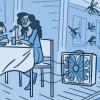
Battling Bites
… As the days grow longer and warmer, summer fun beckons. Swimming, sports, and picnics go hand in hand with warmer weather. But so do bug bites. Mosquitoes in particular can ruin a day … warmer. And others, like West Nile virus, now pop up seasonally in most parts of the country. NIH-funded researchers are working to help stop the spread of mosquito-borne diseases. They’re … easier for a mosquito to suck blood. It also has compounds that help any disease the mosquito is carrying to get into your body. “When you get bitten by a mosquito, you have an allergic …

About Faces
… There’s a reason we can spot a friend in a crowd—humans are wired to focus on faces. We’re incredibly skilled at recognizing small … to eat, hear, speak, see, and breathe. Cranofacial disorders can also harm the growing brain. NIH-funded researchers are working to unravel the mysteries behind how the head and face develop. … … Molding the Face and Head … One way to decipher the underlying biology of the face and head is to gather data—lots of it. Scientists analyze genetic information, take images of people’s …

Biosensors and Your Health
… and maintain healthy habits. These devices have also opened doors for people to participate in health research. Now, researchers are designing more advanced devices called biosensors that … “The variety of biosensors used by researchers, clinicians, and people from every walk of life is growing,” says Dr. Šeila Selimović, a biosensors expert at NIH. “Some speed up test results so treatments can be started promptly. Others provide the …

Managing Diabetes
… You might not notice all it’s doing to keep you healthy until something goes wrong. Diabetes is a serious disease that happens when your body has trouble managing and using blood glucose, a … … Types of Diabetes … How people with diabetes manage their blood glucose levels depends, in part, on the type of diabetes they have. The most common are type 1, type 2, and gestational … a syringe or the help of an insulin pump,” explains Dr. Guillermo Arreaza-Rubín, who heads NIH’s Diabetes Technology Program. Any error in this management may lead to life-threatening …

Medical Robots to the Rescue
… What do you think of when you hear the word robot? Is it a human-like assistant with a friendly face, or a large and menacing foe? Generally, a … Ryan Sochol, a mechanical engineer at the University of Maryland. But medical robots can come in many shapes and sizes. Sochol and his colleagues are creating tiny flexible robots to improve … demand during the procedure to help surgeons reach those hard-to-access areas,” he says. Other NIH-supported scientists are developing soft robotic techniques to improve heart surgery, bowel …

Advances in Childhood Cancer
… they could get something as scary as cancer. But they can. Every year, more than 10,000 kids in the U.S. will get a diagnosis of cancer. Some cases are caused by changes in certain … of cancer that we see in children,” says Dr. Nita Seibel, a childhood cancer specialist at NIH. These are cancers that start in certain types of blood cells. Next most common are cancers … are testing ways to expand gene mutation screening for kids with cancer. One ongoing study is called Pediatric MATCH . The study is trying to match the mutation found in a child’s tumor …

To Heal a Wound
… You’ve likely had countless cuts and scrapes in your life. Normally, when you get a small skin wound, your body can repair it quickly. But … have an open wound, blood can get out of the body, and germs can get in. “So the body’s goal is to seal that wound as quickly as possible,” says Dr. Maria Morasso, a skin biology researcher at NIH. This normally involves an orderly series of steps. First, a clot forms over the wound to …

Your Body’s Bugs
… Microscopic bugs called microbes can be found in your eyes, mouth, gut, skin, and everywhere else. But don’t be alarmed. Most of your microbes … bacteria, fungi, and viruses. Together, it’s called the human microbiome. “The microbiome is just as important as the brain, liver, kidney, or heart,” says Dr. Eugene Chang, who studies … an [qtip:immune system|The body’s defense against germs and microscopic threats.] expert at NIH. “This is one way your microbiome prevents infection,” she says. Your immune system normally …
NIH Office of Communications and Public Liaison
Health and Science Publications Branch
Building 31, Room 5B52
Bethesda, MD 20892-2094
Contact Us:
nihnewsinhealth@od.nih.gov
Phone: 301-451-8224
Share Our Materials: Reprint our articles and illustrations in your own publication. Our material is not copyrighted. Please acknowledge NIH News in Health as the source and send us a copy.
For more consumer health news and information, visit health.nih.gov.
For wellness toolkits, visit www.nih.gov/wellnesstoolkits.