
A monthly newsletter from the National Institutes of Health, part of the U.S. Department of Health and Human Services
NIH Websites Are Changing
NIH is moving the launch of its new website to the fall to ensure the best possible experience for everyone who relies on our websites for health information, research, funding opportunities, and other resources.
Understanding Huntington's
Scientists Search for Therapeutic Targets
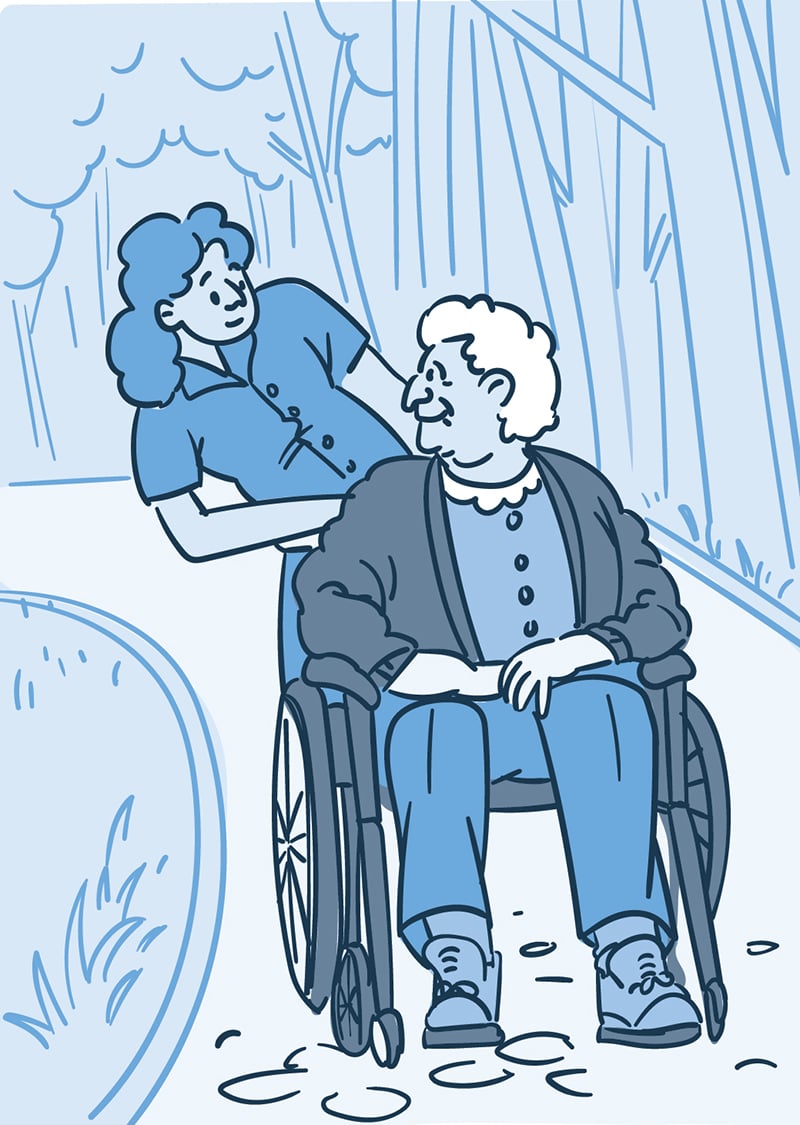
Huntington’s disease can be devastating. The illness reduces your ability to control your body’s movements. It can also give rise to problems with thinking and memory. It’s caused by changes in one gene, and those changes are passed down from generation to generation. Scientists are looking for ways to lessen the impact of the disease.
Huntington’s disease is caused by a gene that makes a protein called huntingtin. Certain changes in the gene cause it to make a defective protein. The defective protein has toxic effects in brain cells, causing them to die. The brain areas most affected are those that control voluntary movements.
People with Huntington’s may develop uncontrollable, irregular movements. These are called chorea. They may also have body stiffness and trouble moving, called akinesia. Symptoms get worse over time, and the disease is eventually fatal.
“Right now, we don’t have a therapy that can prevent the disease, or slow down or stop it,” says Dr. X. William Yang, an expert on neurodegenerative diseases at the University of California, Los Angeles.
As the disease worsens, people can experience problems with swallowing, eating, thinking, emotions, body posture, or speaking. Eventually, they cannot walk or care for themselves. Some people may also have hallucinations or believe things that aren’t true, called delusions.
The problem in the huntingtin gene is in a short DNA sequence that’s repeated multiple times in a row. As the number of those repeats increases, so does your risk for Huntington’s disease.
Most people have fewer than 27 of these repeats. People with Huntington’s disease usually have at least 36 repeats. Those with 27 to 35 repeats are not likely to develop the disease, but they may pass along genes that increase their children’s risk.
The number of these repeats also influences when symptoms appear. “The more repeats, the earlier the disease onset,” Yang says. The disease can start as early as childhood, though that’s rare.
Children inherit two copies of the huntingtin gene—one from each parent. They only need to get one copy of the gene with too many repeats to develop the disease.
A genetic test can tell you how many repeats your huntingtin genes have. But the test itself isn’t a diagnosis. The diagnosis is based on a clinical exam and specific movement symptoms.
Scientists are studying ways to lessen the effects of the disease-causing huntingtin gene. They’re looking at ways to alter the gene and testing how to lower levels of the defective huntingtin protein.
Yang’s team is investigating the role of other genes in Huntington’s disease. They’re studying an animal model of the illness. In these animals, the huntingtin gene gains more repeats during their lifetime, like it does in people with the disease. Yang’s team has found that the extra repeats are added most rapidly in the brain cells most affected by the disease. The changes happened more slowly in animals lacking certain other genes. In these animals, the huntingtin protein is also much less toxic.
Yang thinks these other genes may make good targets for interventions. His team is now searching for molecules that can turn off those genes.
Although we can’t stop Huntington’s disease, there are ways to improve quality of life for people with the illness. Medications are available that decrease uncontrolled movements, curb hallucinations, and soothe emotional symptoms.
Identifying the disease as early as possible may make those treatments more effective.



NIH Office of Communications and Public Liaison
Health and Science Publications Branch
Building 31, Room 5B52
Bethesda, MD 20892-2094
Contact Us:
[email protected]
Phone: 301-451-8224
Share Our Materials: Reprint our articles and illustrations in your own publication. Our material is not copyrighted. Please acknowledge NIH News in Health as the source and send us a copy.
For more consumer health news and information, visit health.nih.gov.
For wellness toolkits, visit www.nih.gov/wellnesstoolkits.