
A monthly newsletter from the National Institutes of Health, part of the U.S. Department of Health and Human Services
NIH Websites Are Changing
NIH is moving the launch of its new website to the fall to ensure the best possible experience for everyone who relies on our websites for health information, research, funding opportunities, and other resources.
The World Inside Your Mouth
How Mouth Microbes Affect Your Health
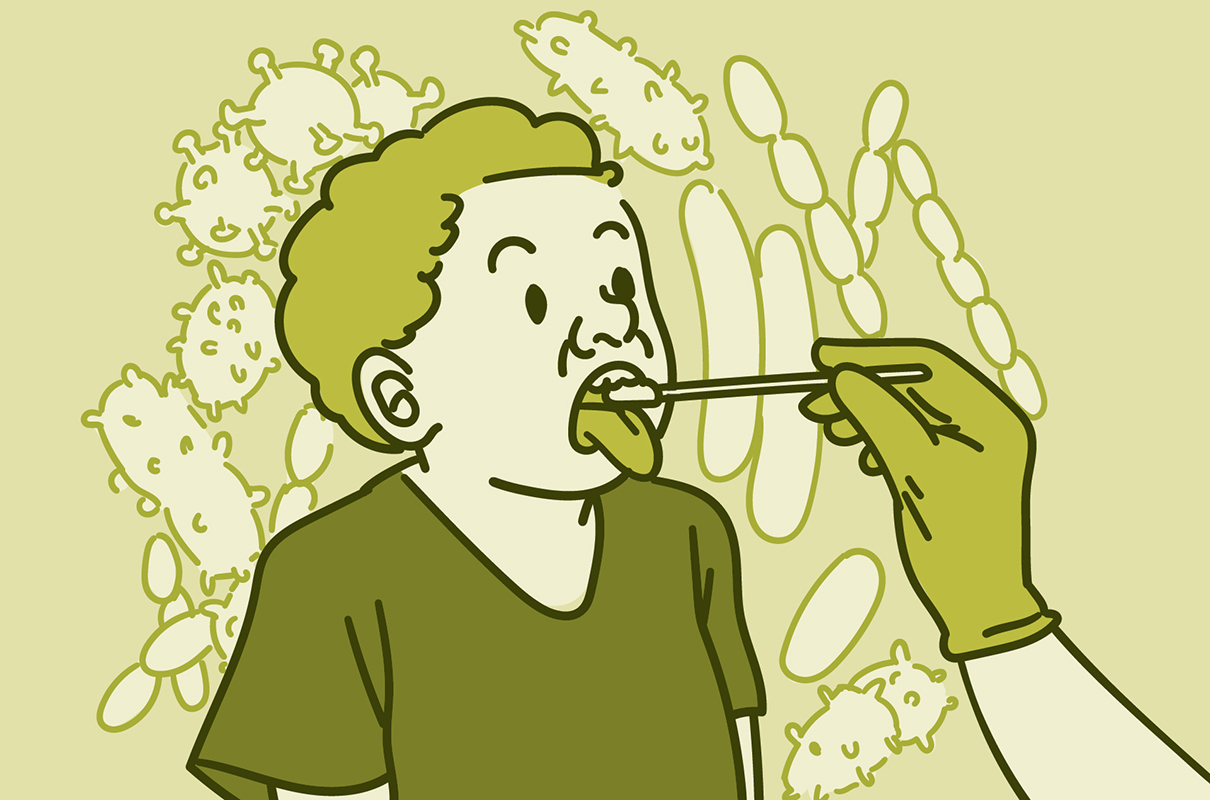
There’s much more to your mouth than your teeth, gums, and tongue. Your mouth also contains billions of tiny critters that can only be seen with a microscope. These are called Microscopic germs like bacteria, fungi, and viruses. microbes. Together, all the microbes living in your mouth are known as the oral microbiome.
Scientists believe the oral microbiome can contribute to diseases both in the mouth and elsewhere in the body. That means research into these microbes might lead to new ways to prevent and treat many illnesses.
Who’s in There?
Your mouth makes a lovely neighborhood for microbes. And many different types can move in. Scientists believe roughly 700 species of microbes live in the human mouth. Some of these may contribute to diseases. Others help keep disease-causing microbes from taking over.
“It’s a natural, normal part of life to have these microbes living in your mouth,” says Dr. Christian Abnet, an oral cancer researcher at NIH. “Even people with good oral hygiene have a thriving microbiome in their mouth.”
The set of microbes in a person’s mouth usually doesn’t change much over time, at least in adults. When it does change, it can be bad news.
“People tend to have certain microbes in specific proportions,” says Dr. Akintunde Emiola, a researcher who studies the oral microbiome at NIH. “When that proportion changes, that can be linked to diseases.
But which specific microbes are linked to diseases isn’t clear. Researchers are trying to figure out how microbe changes in the mouth play a role in disease.
Beyond the Mouth
One kind of microbe that can wreak havoc in the mouth is bacteria. Dentists are well-known for pointing out that sugar-loving bacteria can harm your teeth and gums. These live in the plaque that dentists scrape off your teeth.
But the influence of these microbes is not confined to the mouth. Mouth microbes have been linked to a wide variety of diseases outside the mouth. These include cancer, heart disease, diabetes, allergies, asthma, and even Alzheimer’s disease.
For example, studies have shown that poor oral health is linked to a higher risk for Alzheimer’s disease. That may be because not taking proper care of your teeth makes your mouth a friendlier place for disease-causing bacteria.
“We think the type of bacteria that live in the mouth might secrete substances that can get into your bloodstream, go into the brain, and cause things to go awry,” says Dr. Colin Combs, an expert in neurodegenerative diseases at the University of North Dakota.
Combs’ team has found a substance linked to Alzheimer’s disease inside our mouths. Beta-amyloid is a hallmark of Alzheimer’s disease. In the brain, it clumps together into “plaques.” But Combs’ work recently showed that beta-amyloid is also in saliva.
His team is researching how beta-amyloid in saliva affects mouth microbes, and vice versa. They’re trying to figure out whether beta-amyloid in the mouth plays a role in Alzheimer’s disease, too.
Cancer may also be influenced by the oral microbiome. Abnet’s studies have linked certain mouth microbes to a higher risk for cancer in the lungs, colon, and esophagus.
Abnet explains that there are a few ways mouth microbes might promote cancer. One is that certain bacteria produce substances that cause cancer. These are called carcinogens.
The oral microbiome can also affect the defenses that protect you from germs. Those defenses are called the immune system. One of the ways it fights off germs is with a reaction called Heat, swelling, and redness caused by the body’s protective response to injury or infection. inflammation. Inflammation is linked to many diseases, including cancer and Alzheimer’s disease.
Changes to the immune system might also explain how mouth microbes affect allergies. An allergy occurs when the immune system overreacts to something that’s normally harmless. Take, for instance, peanut allergy in kids. One study showed that when kids have certain mouth bacteria, it takes a smaller amount of peanut to trigger a reaction.
Knowing how mouth microbes are linked to diseases might one day help us create new treatments.
“Figuring out the mechanisms is really important if you want to design an intervention,” Abnet says.
Managing Our Microbes
Getting rid of disease-causing microbes in our mouths is easier said than done. There are medications that kill microbes, called antibiotics. But current antibiotics kill off all kinds of microbes, not just harmful ones. That’s why Emiola’s team is working on more precise ways to destroy disease-causing microbes.
“When you kill all of the microbes, the problematic ones tend to repopulate faster,” Emiola says. “But if you specifically target the bad microbes, that allows the good ones to repopulate the environment.”
His lab is looking for viruses that only infect specific bacteria. These viruses are called bacteriophages. Using bacteriophages that prey only on specific bacteria in the mouth could be a way to get rid of disease-causing microbes.
Emiola’s group is also trying to create medications that only harm certain bacteria. To do that, he’s relying on treatments called prodrugs. “Prodrugs are compounds that are normally inactive,” Emiola says.
But the prodrugs he is developing become active once inside specific bacteria. And when they’re activated, they work like antibiotics.
In fact, his team has already created a promising prodrug that eliminates bacteria that cause severe gum infections. And he believes this approach could one day help treat diseases outside the mouth as well.
Meanwhile, many “probiotic” and “prebiotic” supplements can already be found in grocery stores. They’re often promoted for their ability to make the microbiome healthier. A prebiotic encourages the growth of certain microbes. A probiotic already contains those microbes. But researchers still don’t truly know which microbes or combination of microbes are effective.
“There’s really very little evidence [on specific supplements]…, so that would not be anything that I would recommend,” Abnet says.
Fortunately, there are many evidence-backed ways to have a healthier oral microbiome. The habits that make for a healthy lifestyle also happen to be good for the oral microbiome. That includes good dental hygiene and a well-balanced diet.
“Maybe one day we’ll have [microbiome-based treatments that are] beneficial to people,” Abnet says. “But we’re in the early days of that research right now.”
See the Wise Choices box for more tips that are good for both you and your mouth microbes.




NIH Office of Communications and Public Liaison
Health and Science Publications Branch
Building 31, Room 5B52
Bethesda, MD 20892-2094
Contact Us:
[email protected]
Phone: 301-451-8224
Share Our Materials: Reprint our articles and illustrations in your own publication. Our material is not copyrighted. Please acknowledge NIH News in Health as the source and send us a copy.
For more consumer health news and information, visit health.nih.gov.
For wellness toolkits, visit www.nih.gov/wellnesstoolkits.